



As a wealthy, developed country, it's a bit strange that Canada still doesn’t have high-speed rail. Montreal, Toronto, Ottawa, and various other cities are lined up nicely, and unlike Italy, Spain, Korea, or Japan, there are no mountains to speak of getting in the way.
The biggest cities in Quebec City-Windsor are also fast-developing respectable public transport systems. In just the 2000s Ottawa has gone from no rail at all to a network bigger than the C-Train in Calgary; Montreal is adding a system the size of the Vancouver SkyTrain in the span of fifteen years; and Toronto’s subway is growing by over 30%, while the GO train network means daily bidirectional services to Hamilton, Barrie, and Kitchener, and more frequent service in the urban core. And yet the trains between these cities – expensive new trains – plod along stuck between freight train land barges filled with Toyotas and Canadian Tire merchandise.
The commitment to high-speed rail made by the Liberals is a big deal for the country. Few things could be more powerful for nation-building than linking French and English Canada with high-speed ribbons of steel, not unlike – France and England. The project would be able to work to address so many things Canadians care about: boosting domestic tourism, improving productivity and competitiveness, reducing emissions, and improving affordability.
And yet the project is having the usual problems. Planning decisions are questionable, costs are coming in high, and political meddling means forced changes to the project seemingly every year. Under the Liberal Federal government – which has been in power long enough to have delivered some real improvements – passenger rail is totally stagnant. Meanwhile this project has been metamorphosing in place, coming out of a rational if underambitious plan set out by the previous Conservative government, and turning into full high speed rail.

It’s sad then, that much of the commentary I’ve seen from serious Conservatives just seems to suggest that while high-speed rail would be great, that we can’t or won’t deliver it, and should more or less give up on this “Liberal boondoggle”. I understand a frustration with Canada’s seeming inability to get big projects across the line in a timely manner, but this attitude that we can’t fix this (though I think the reality is more complex than Canada being universally bad at delivering big projects) just ends up spiralling into pure nihilism.
The nuanced reality of transport project construction in the country is that under the right conditions, projects have actually done quite well. Montreal's REM project is in many ways a Canadian Conservatives wet dream: The project delivers massive new high-frequency urban rail to suburban areas, without taking space away from cars, and at a low cost. The project did this quickly in no small part by utilizing extremely talented private sector workers in one of Canada's extremely successful pension funds to coordinate the whole effort.
The nihilistic view just doesn't make any sense. Perhaps on an individual level you might not be optimistic. However, when much of your political movement appears to believe in our permanent inability to construct anything that we desire, then what's the point of voting for you? If we aren’t going to build anything no matter what, be we could be positive or negative, I think most people would rather not wallow in their sorrow.
When Pierre Poilievre had an opportunity to look at Alto – a useful project, even if only a grain of one, and suggest that a Conservative government unlike the Liberals would actually deliver something – he instead chose to side with rural NIMBYs, for whom the prospect of a one in a thousand chance that a tiny sliver of their property – for which they will be compensated – is expropriated is sufficient to set up groups suggesting the project is some massive atrocity.

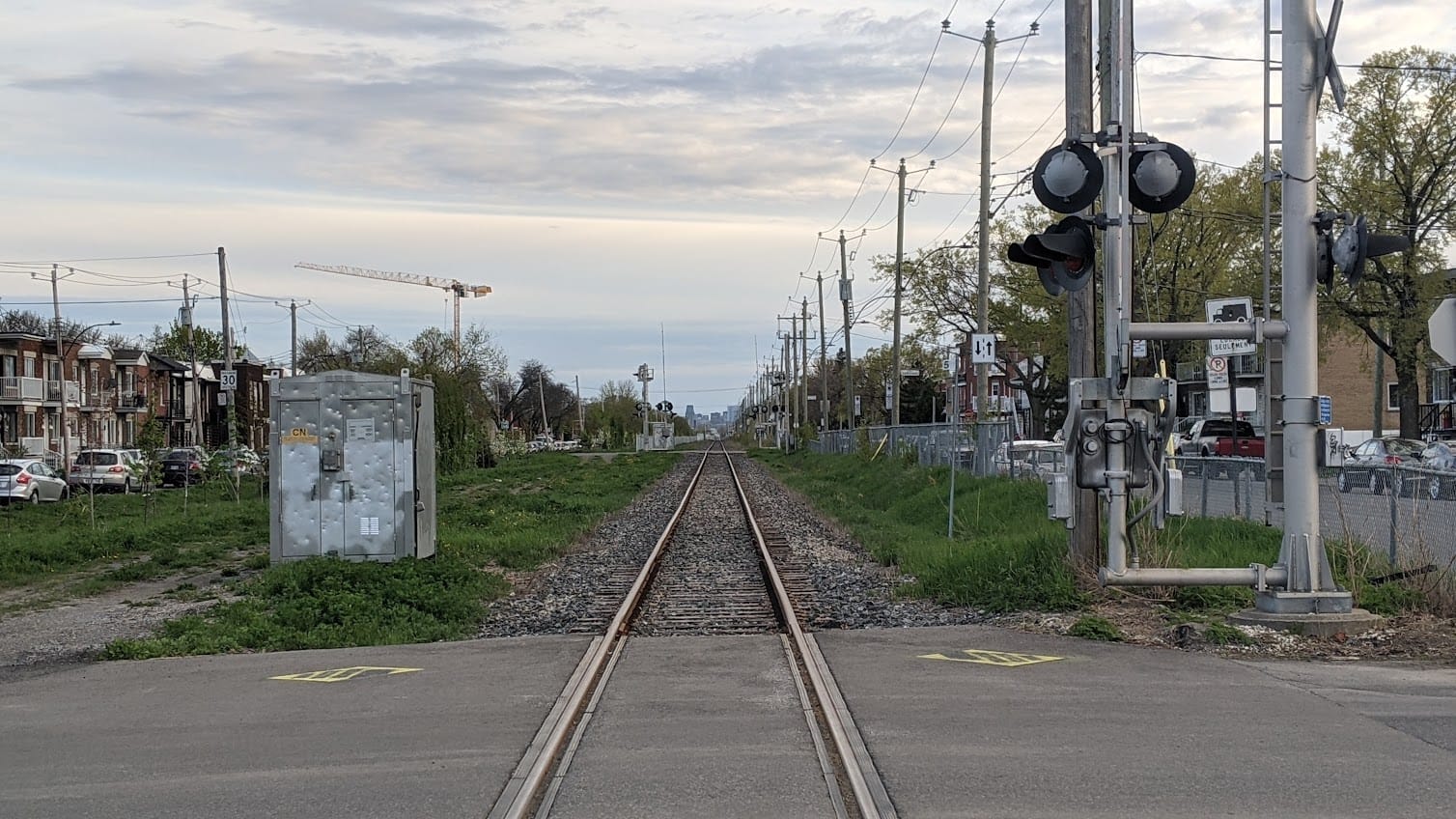
Avenue Souligny in Montreal where the REM de l'est was canceled due to progressive politicians caving in to NIMBY opposition
Now, maybe Poilievre thinks that only if the government gets out of the way – as he often says – projects will be completed, it's not clear what this portends for public works, but perhaps more importantly it feels contradictory with governmental ambitions. “Government is bad and must get out of the way!” Okay, so why would we elect you to form a government?
If Poilievre was wise, he might suggest the problem is Alto itself. Canadian governments have a strange habit of engaging in public-private partnership transit projects and then enabling the public half of that partnership – which has next to no expertise in modern transit or rail development – to smother the private partner. And yet it was the Quebec Liberal government that created the privately-driven REM. Meanwhile the Ontario Conservatives had Metrolinx directing its partner the German national railways on how to build and run railways - something they were not qualified to de.
What’s more concerning is that if the tendency is to side with NIMBYs, how will we as a nation manage to build – oft opposed by neighbours – housing? The reality is that (as recently discussed on Canadian Civil) when issues like housing are put to a Conservative public, those Conservative “get government out of the way” values are thrown to the wind. The Federal Conservatives want far more resource projects built to export things like oil, are they going to side with the huge number of people across BC who don’t want this infrastructure, in which they have even less of a stake than the farmers with Alto?
Now, former conservative leader Erin O'Toole had a slightly more measured take saying that the Alto project imposed financial risks which were too large.
Another good warning about the financial risks of Alto. It is also a great reminder that spending a fraction of the Alto amount to reduce transit times in Canada’s largest cities would be a much smarter plan to benefit more Canadians.https://t.co/JBbYlYQLsu
— Erin O'Toole (@erinotoole) June 26, 2026
But again, wouldn't the point of electing the Conservatives to government be to better manage risks, impose cost discipline, and sort projects out? This seems like the sensible path in a country where – naturally – most support high-speed rail.
The alternative was to suggest that we should just do urban transit projects and this isn't necessarily completely irrational, but there also is no free lunch. If you've been paying any attention, you'll know that urban transit projects face all of the same political, technical, and cost challenges that high-speed rail faces. And so you're just trading one problem for another of the same kind, without actually delivering the thing we're lacking – after all, the whole reason we are doing high-speed rail is because everyone recognizes that the existing VIA rail service and operation is an embarrassment. At the same time, Canadian cities are getting a lot of urban transit right now, thanks in large part to the Federal Liberals, making the leader look disconnected from the whole topic. The reality is that we could afford to have urban transit and high-speed rail, if only a competent government would come in and bring down the prices to the thrifty level of Spain, Italy, or South Korea. Suggesting that we could have more urban transit if we didn’t pursue intercity transit shows you’ve lost the plot.
Unfortunately, what followed that measured if disappointing critique of the project was the worst of politics. Talk of a more reasonable alternative is – and I'm not kidding here – electric air taxis, which Erin suggested will exist by the time high-speed rail could be completed.
We looked carefully at High Speed versus High Frequency rail and $ was much too high for a relatively modest benefit. And in a crossover from your other post comment, this will be a real option by the time Alto would be built. Electric and 🇨🇦 tech.
— Erin O'Toole (@erinotoole) June 27, 2026
👇https://t.co/Mpygxsvzpm
These electric air taxis are one of those modern-day technologies that seemingly endlessly getting demoed, but which doesn't seem to have been actually rolled out in a serious commercial service anywhere. It's a lot like a hyperloop, and promoting it doesn’t make you seem more serious than a government that struggles to deliver, but at least doesn’t promote snake-oil.
High-speed rail is at this point a mass-production product available in numerous countries with commercial platforms that exist from numerous manufacturers. It's not a new or risky thing and countries quite regularly complete projects spanning significant distances in just a handful of years. This is not so different from how Canada has built pipelines or highways in the past. That a Conservative would suggest both that the country is just fundamentally incapable of building a big project, when the Conservatives clearly would probably like you to build some pipelines and highways is pretty confused, but what's even more concerning? Fawning over a technology that doesn't even really exist as a real commercial product and pretending that it's something that can even come close to competing with a mass transit solution that is used by millions of people every day around the world – because well, it’d be Canadian! It spells out a version of the Conservative party that isn't rational or oriented around real solutions that exist out in the world, but over fantasy and not in fixing the real procedural problems that the state in Canada faces. That we are deluded into thinking that Canada will out engineer Germany, France, China, Japan, and even the US – with a novel “one simple trick” made in Canada solution feels like the worst of Liberal governance!
Conservatives need to offer vision – a positive vision. It can’t be cancelling things people want, or solely defined around things they won’t do. It certainly shouldn’t be about too-clever made-in-Canada solutions that reinvent the ... flying car.
While I’m not a partisan, I think the fundamental idea of competition is important, even when applied to political parties. The solution to out flanking the Liberals – something which the Conservatives keep struggling to do – is not to suggest cancelling infrastructure because some people are pissed off and selfish, or suggesting that a Canadian tech demo will replace a battle tested technology developed over decades and deployed around the world, but delivering the things people already want competently.
It’s obvious that Liberal and broad progressive policies are in no small part the reason our infrastructure projects are so slow and expensive, and so the obvious thing for Conservatives to do is to say they will change the policies. Instead, they chase gadget solutions and not so popular populism, and even if this stuff wins an election – which seems unlikely, it won’t deliver results.
Conservatives need to offer vision – a positive vision. It can’t be cancelling things people want, or solely defined around things they won’t do. It certainly shouldn’t be about too-clever made-in-Canada solutions that reinvent the ... flying car.
Instead, I might suggest running on a vision of competence. Liberals promise a lot, and deliver far less. What if Conservatives just trimmed the worst ideas, and delivered the rest?


Member discussion